

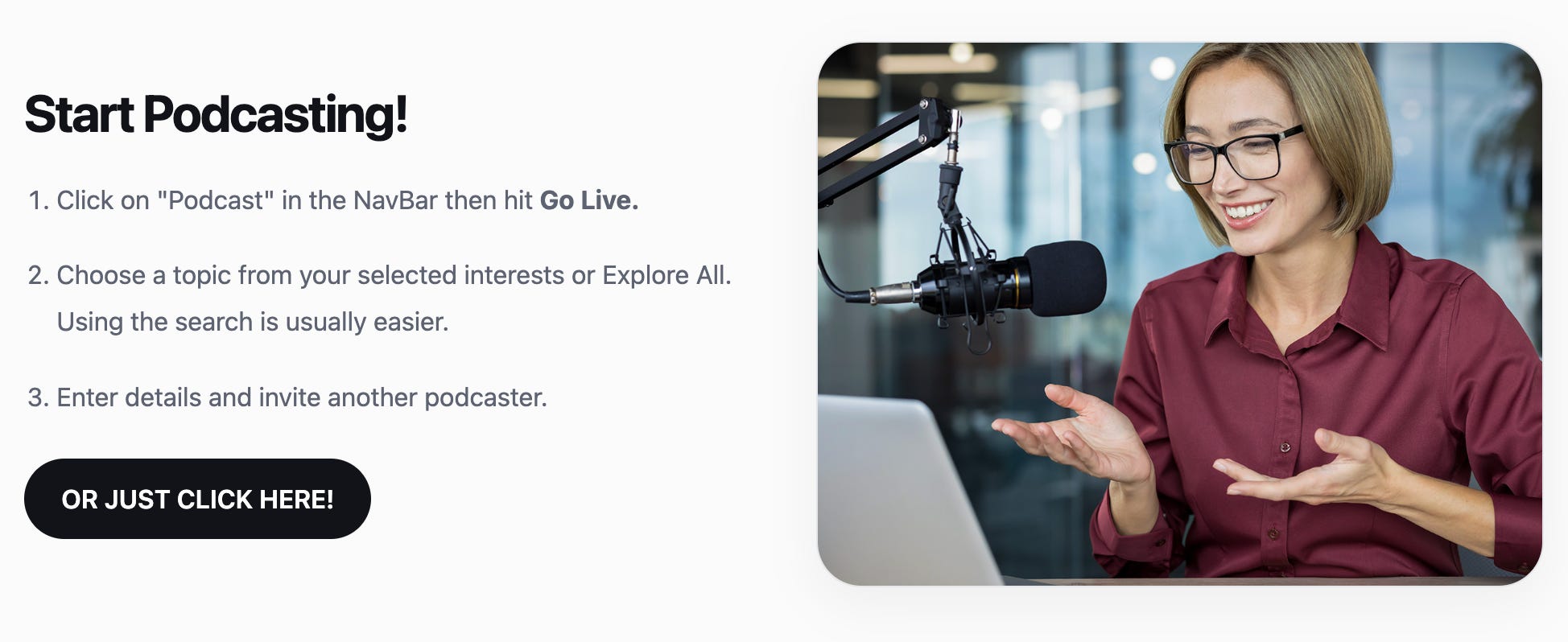
Somebody recently pointed me toward a platform for conversations that's still finding its footing. I’m not going to name it yet. I might do a whole episode on it later, but here’s the pitch: you and a co-host hop on something that looks a lot like a Zoom call, people watch it live, they drop comments in a chat window, and the button you click to make this happen says “Start a Podcast.”
And I sat there looking at it thinking, okay, in what universe is this a podcast.
Then I caught myself, because I’ve had this argument before, on both sides, and I already know where it goes.
There’s a camp of people who will tell you a podcast is only a podcast if it comes out of an RSS feed. Doesn’t matter what it sounds like, doesn’t matter if it’s two people rambling for ninety minutes about baseball or true crime, if there’s no feed, it’s not a podcast. It’s something else wearing a podcast costume. And look, I get the appeal of this argument. RSS is genuinely the reason podcasting didn’t turn into another walled garden back when it had the chance to. Nobody owns the feed. You can listen in Apple Podcasts or Overcast or some app built by a guy in his basement, and the show doesn’t care, because the show isn’t asking permission from a platform to exist. That’s real, that matters, I’m not going to pretend otherwise.
But I’ve also got to admit, it’s another kind of purity test, and purity tests are exactly the kind of thing this show exists to make fun of. Real podcasters use RSS” is first cousin to “real creators post every Tuesday at nine.” It sounds like a technical fact but it’s doing the same job as every other guru rule, which is making somebody feel like they’re doing it wrong so they’ll buy the fix.
Then there’s the other camp, the one that just goes by feel. Two people, big headphones, long conversation, and it’s a podcast, full stop, doesn’t matter if it’s sitting on Twitch or locked inside Spotify’s app or streaming on Rumble with no download option anywhere. This is basically how the entire public already talks, and there’s nothing wrong with that. Language moves the way people use it. I’m not going to correct a hundred million listeners on etymology. But this camp has its own blind spot. It’s all about the aesthetics. Microphones and a couch and a slow, meandering conversation register as “podcast” regardless of what’s actually happening underneath, which means a company can borrow every ounce of goodwill the word has earned over twenty years without touching any of the architecture that earned it.
Which brings me back to the platform with the “Start a Podcast” button, and here’s what actually bothered me about it, once I got past the reflexive purist reaction.
It’s not that the RSS crowd is wrong that something’s missing. It’s that they’re pointing at the wrong missing thing. The feed itself was never the point. The feed was just the mechanism that happened to guarantee something people actually care about, whether they’ve thought about it in these terms or not: you hold your own list. Your audience is yours. You can pack it up and move it to another host tomorrow morning, and every single subscriber comes with you without lifting a finger. That’s the whole trick. RSS matters because of what it protects, not because it’s some sacred technical ritual you have to perform to earn a merit badge.
So when a closed platform hands you a “podcast” button, the question worth asking isn’t whether it counts by some dictionary definition. It’s what happens the day that platform changes its terms, or gets bought, or decides your kind of show doesn’t fit their new direction anymore. Where does your show go. Who has the list. If the answer is “nowhere” and “them,” you didn’t start a podcast, you started a tenancy, and you’re renting the thing you think you own.
You don’t need an RSS feed to be legitimate. You also don’t need a webcam and a chat window to be relevant. What you need to know, before you get attached to a platform or a format or a button that says the right word, is whether you can leave. That’s the only best practice in this whole mess that’s actually worth following, and it’s got nothing to do with what a podcast technically is.