

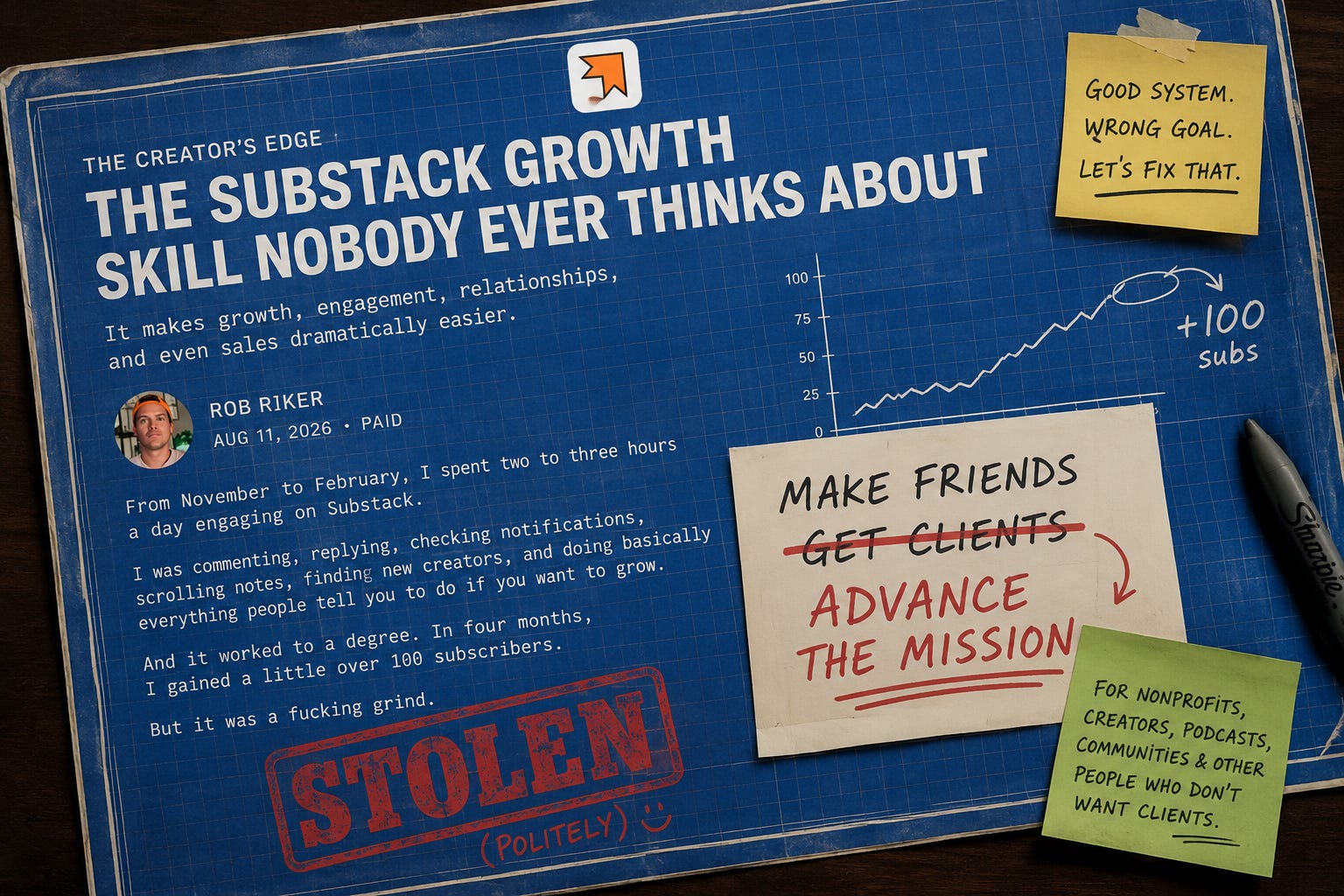
Rob Riker, who generally writes about relationship building, is definitely worth a follow. He wrote an article recently, The Substack Growth Skill Nobody Ever Thinks About, where he introduces a system he calls Make Friends Get Clients.
For those of us where “get clients” is not our ultimate goal, that’s actually the least interesting part of the system. The underlying mechanism is relationship-building around a shared interest or mission. That makes it surprisingly transferable to nonprofits, community organizations, independent creators, advocacy groups, and even podcasts.
You should definitely check out Rob’s post cited above. In the spirit of “Steal Like an Artist” a modified version of his “system” that removes the client metaphor entirely might look something like this:
Make Friends, Advance the Mission
Build Your Foundation
Get clear on what you do, who you serve, what you believe, and what you want to be known for. Attention is more useful when people can quickly understand why you exist.Find the Right People
Identify writers, creators, organizations, communities, journalists, experts, supporters, and people who already care about the territory you’re working in.Become Recognizable
Show up consistently in their world. Read their work. Leave thoughtful comments. Share things you genuinely find useful. Become a familiar name rather than another account trying to get noticed.Start Real Conversations
Move beyond engagement metrics. Talk to people. Learn what they’re working on, what they care about, and where your interests overlap.Create Opportunities
Eventually, relationships create possibilities: a collaboration, introduction, interview, guest post, event, volunteer, donation, membership, partnership, media mention, referral, or simply someone who tells ten other people about your work.
And the important bit is the same:
You aren’t networking because you want something from people. You’re building relationships with people you actually value.
Connecting this to other conversations we’ve had around platforms and ownership, a key thing here is: the real asset isn’t the audience you temporarily accumulate on Substack. It’s the relationships you develop with actual people. Substack can disappear, change the algorithm, change the economics, or decide you’re doing something wrong. The people you’ve actually gotten to know are portable.
The “How to consistently find the right people” part of Rob’s system is behind the paywall, so I don’t know what his secrets are on that. You can become a paid subscriber of his to get those details.
I could be way off, but what I’d say is some combination of finding people who already have the audience, interests, and behaviors you want to be adjacent to.
Some of these are probably obvious, but here’s a few ideas:
1. Find the writers your ideal readers already read.
Search Substack by topic, then look at who consistently appears in recommendations, Notes conversations, and comments.
2. Mine the recommendations graph.
If Writer A recommends Writers B, C, and D, and B recommends E and F, you’ve got a little interest graph. Follow it outward.
3. Look at commenters, not just authors.
This is probably one of the more valuable tricks. Someone leaving thoughtful comments on five newsletters in your niche is potentially more interesting than a giant account with 200,000 followers.
4. Find “adjacent” audiences.
Don’t just search for nonprofit. Search for the topics your nonprofit actually lives in. A food bank might want to find writers covering food insecurity, poverty, local government, community organizing, mutual aid, restaurants, philanthropy, etc.
5. Find people who are already talking about the problem.
The best prospect isn’t necessarily someone who follows your organization. It’s someone who has demonstrated that they care about the problem you’re trying to solve.
6. Follow the people who interact with the people you want to know.
This is the second-order network. If a writer has a particularly interesting group of commenters and recommenders, those people are often worth exploring.
7. Look for small accounts with unusually high engagement.
A 300-subscriber newsletter where the author knows half their readers may be much more valuable for a relationship than a 30,000-subscriber publication where you’re invisible.
8. Identify “connectors.”
Some people seem to know everyone in a particular niche. They may not have enormous audiences themselves, but they’re disproportionately valuable because introductions travel through them.
9. Start with people you genuinely want to read anyway.
This may actually be the real secret. If the process requires you to spend two hours every morning pretending to care about 50 “ideal accounts,” you’ve built a new job.
Funnels talk about conversion. For those of us that don’t have a course to sell, but have a mission and message to promote, conversion can mean almost anything.
Someone reads your newsletter and becomes a donor.
Someone introduces you to a foundation or industry organization.
A journalist discovers your work.
Another organization proposes a joint project.
A volunteer joins.
A researcher offers expertise.
A local politician notices an issue.
A much larger newsletter mentions you.
Someone simply becomes the person who tells everyone else about you.