

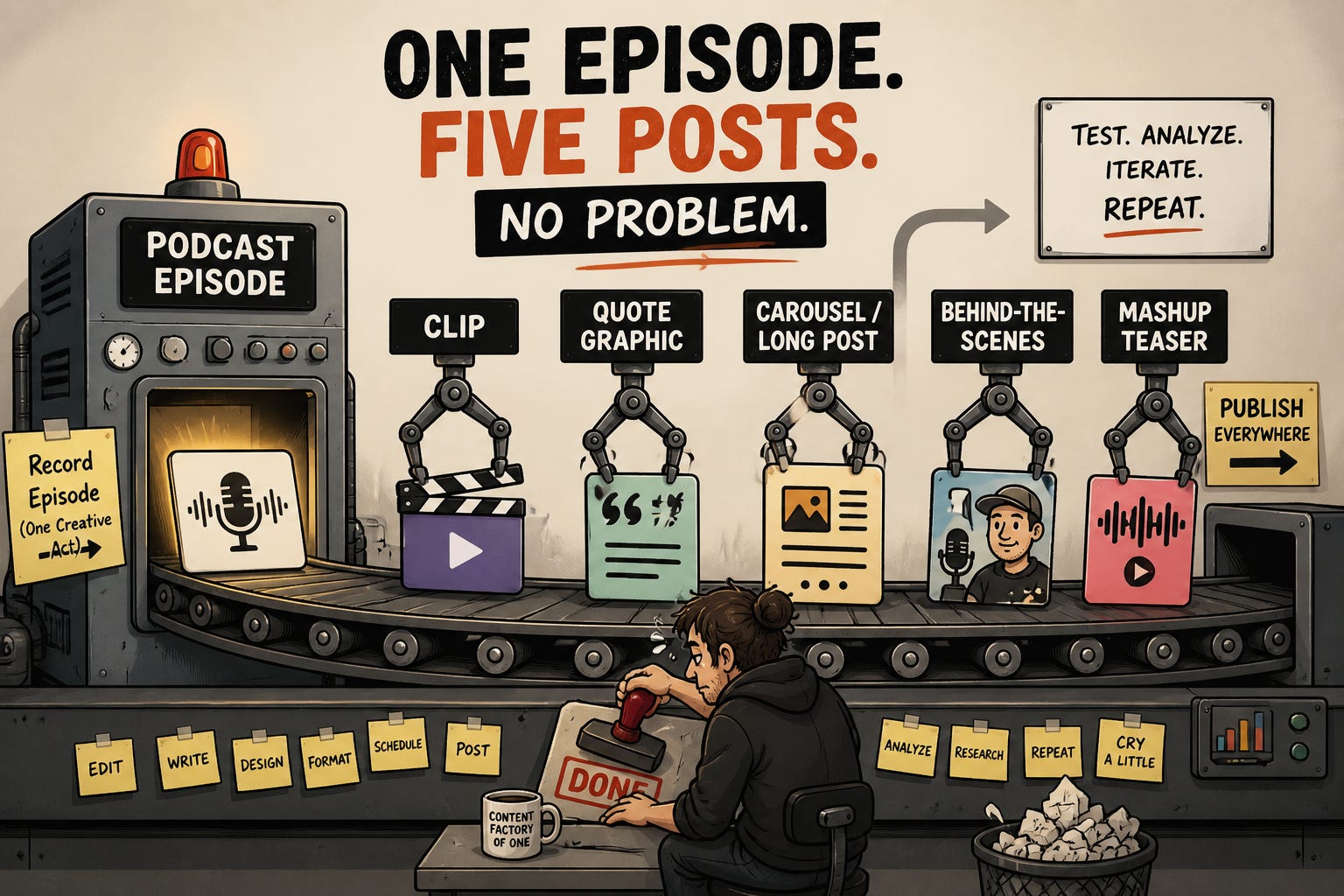
Last week I argued you can’t out-consistency a machine. Let’s talk about what that looks like in practice…
I was recently reviewing advice from a company whose business model benefits from you feeling the need to post social media content frequently. Not surprisingly, they suggest posting consistently. And they want to help you. If you’ve found that even if you are posting consistently, you’re still not seeing results, you must be doing it wrong. But don’t worry, they’ve got a “simple workflow” to fix your problem. The advice sounds efficient in theory. But the real workload becomes much clearer when you take a closer look.
Here’s the workflow underneath the advice, stripped down to the operational steps:
Record a podcast episode.
Extract multiple content formats from the episode:
Reel or video clip
Quote graphic
Carousel or long-form text post
Behind-the-scenes image
Teaser or mashup clip
Publish all formats across platforms.
Monitor engagement metrics:
Likes
Shares
Comments
Saves
Watch time
Follows
Compare performance across formats.
Identify high-performing post types.
Remove or reduce low-performing formats.
Produce more variations of successful formats.
Shape future content around engagement patterns.
Design posts around shareability and audience response.
Maintain a consistent publishing schedule to generate enough data for analysis.
Repeat the cycle continuously.
It’s amazing how fast this “simple advice” turns into a recurring media operation.
A real implementation of this strategy requires video editing, graphic design, copywriting, content planning, and performance analysis. A solo podcaster handles every one of those roles personally.
The strategy itself makes sense for organizations with staff and production capacity. More formats create more opportunities for discovery and distribution. A solo creator experiences the strategy differently because every additional format increases the amount of operational work attached to a single episode.
“Consistency Is the Floor”
That phrase carries a specific assumption about growth. It frames audience growth as a direct result of output volume and execution quality.
Most indie podcasters operate with limited time, limited energy, and limited distribution reach. Many work without an audience team, production support, or promotional infrastructure. Consistency under those conditions functions as ongoing maintenance work. The schedule keeps moving whether growth arrives or not.
The Workload Behind Repurposing
Repurposing content requires editing, writing, formatting, scheduling, and publishing. Five posts attached to one episode can easily consume several additional hours.
The work continues after publishing through analytics reviews, experimentation, and format adjustments for future episodes.
One creative project expands into a recurring operational commitment.
The Tool Promise
Content tools reduce friction and accelerate production tasks. They help creators edit faster, publish faster, and manage more formats.
But we can assume by this suggestion from the tool creator themselves, that alone isn’t enough. There’s more to it.
The core decisions still require attention and judgment. Someone still chooses the clips, writes the copy, evaluates performance, and decides which formats deserve continued effort.
The software improves the workflow. The workflow still exists.
A Different Approach
A solo podcaster benefits from deciding which activities deserve sustained effort.
That can include lighter social media usage, irregular posting schedules, or long stretches without promotion. Podcasting does not require constant platform activity.
Time and energy can move toward stronger episodes, listener relationships, or simply maintaining a pace that remains enjoyable over time.
More content creates more visibility opportunities. Sustainable output creates longevity.
The Tradeoff
Every additional piece of content draws time and energy away from something else. The tradeoff often affects episode quality, personal bandwidth, or long-term motivation.
A podcast becomes harder to sustain once the surrounding workload grows larger than the creative process itself.
The Takeaway
This advice turns optional tactics into perceived obligations. And these tools that promise to do everything for you, obviously don’t, by the tool makers own admission.
A podcaster can publish episodes without building a full content pipeline. A creator can focus on the show itself without maintaining a presence on every platform.
The podcast can remain the primary project. Everything else stays optional.