

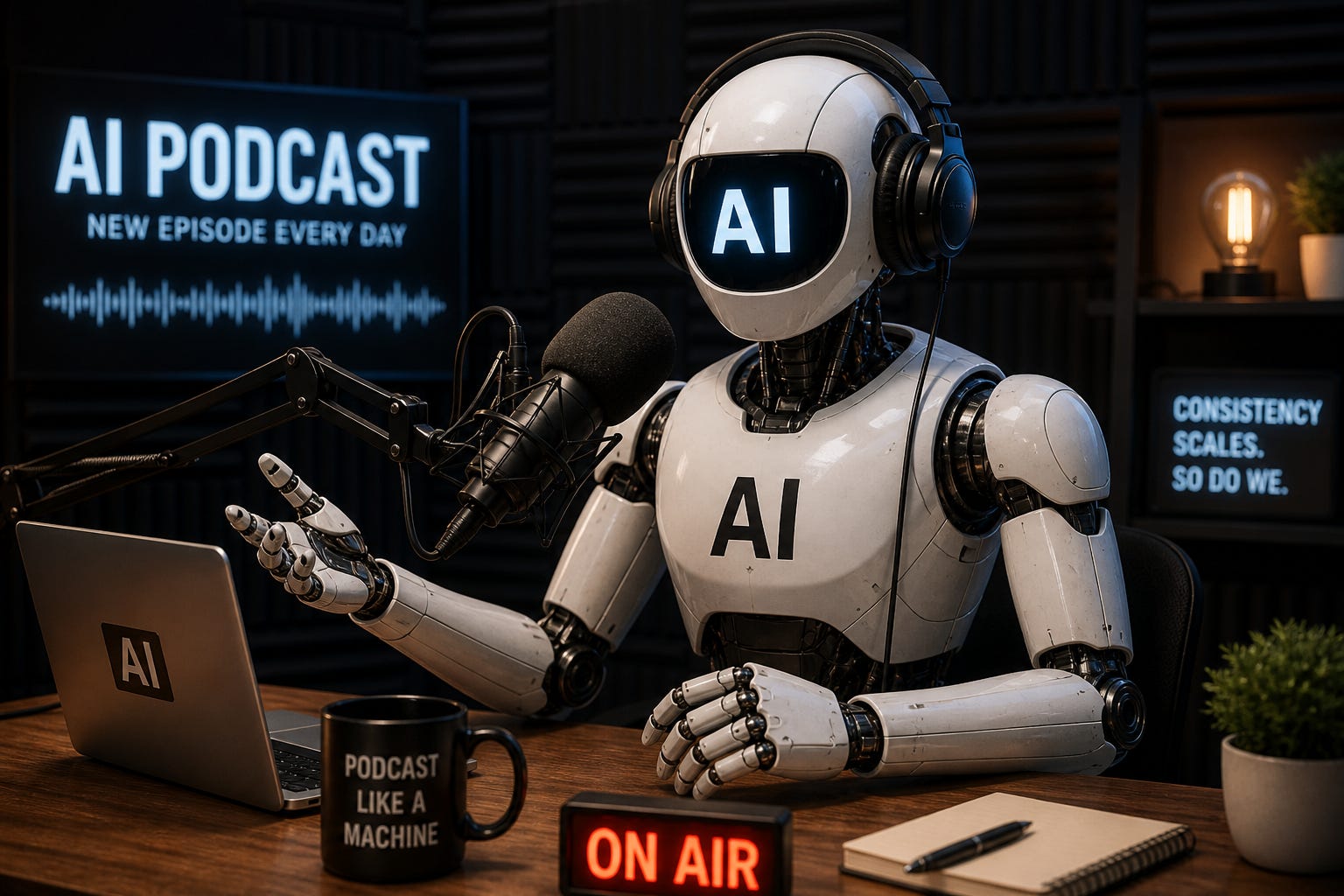
“Welcome to the modern era of podcasting in which thousands of new shows are released into the world every day…”
That’s how Bloomberg frames it in a recent article The Audio Industry Is Grappling with the Rise of ‘Podslop’ (paywalled). Podcasting is an industry suddenly flooded with content, much of it likely AI-generated, much of it barely distinguishable from the rest.
In the past nine days or so, 10,871 new podcast feeds have been created; approximately 4,243, or 39%, might have been AI-generated
The questions that follow are predictable:
What should platforms do?
How do we define “slop”?
How can shows stand out in this sea?
But there’s a more uncomfortable question sitting underneath all of that:
What if nothing has gone wrong?
What if this is exactly what happens when you build an ecosystem around one core idea:
that more content is always better?
For years, podcasting advice has quietly revolved around that idea.
More episodes.
More consistency.
More output.
More “showing up.”
And now, for the first time, that idea has been fully realized.
Not by podcasters—but by software.
Here’s a recent ad I received:
“How do you make $17,000 in 3 weeks from a podcast you never recorded?”
“[This tool] publishes a new AI-generated podcast episode every day… using my own cloned voice… released to Spotify, Apple Podcasts and dozens of platforms automatically.”
“The audience builds while you sleep.”
Eventually, someone figured out the obvious next step:
remove the part where you show up.
The uncomfortable truth is that scale was never really a creative advantage—it was just the only lever available.
You couldn’t outproduce a media company, but you could outwork the average hobbyist.
You couldn’t guarantee quality, but you could guarantee frequency.
So the entire ecosystem quietly shifted toward rewarding volume.
Not because it was meaningful. Because it was measurable.
And now that lever is gone.
You are not going to out-consistency a system that can generate 800+ new shows in 48 hours.
You are not going to “stay top of mind” against something that can be everywhere at once.
And if your strategy depends on either of those things, it’s less a strategy and more a nostalgia act.
This is the part where people usually pivot to:
“Okay, so just make better content.”
But that’s not quite right either.
Because the real shift isn’t from more → better.
It’s from scale → signal.
Scale says:
Publish so often they can’t ignore you.
Signal says:
Say something they can’t ignore.
Those are very different games.
One rewards volume. The other punishes it.
Here’s the irony: the more content floods the system, the less useful content itself becomes as a differentiator.
When everything is available, attention doesn’t go to the most prolific.
It goes to the most distinct.
Not the show with the most episodes.
The show that feels like it could only come from one person.
Which creates a slightly inconvenient reality for anyone who’s been following the “best practices” playbook:
Consistency is no longer impressive
Volume is no longer defensible
Optimization is no longer a moat
Those weren’t unfair advantages. They were temporary ones.
And temporary advantages don’t survive automation.
So what actually holds up?
Not scale.
Not polish.
Not even efficiency.
What holds up is friction.
The things that don’t scale well:
a specific point of view
a voice that isn’t interchangeable
choices that are a little too weird to optimize
ideas that take longer to form than to publish
In other words, the parts of podcasting that always felt a bit inconvenient.
Friction is valuable because it slows you down just enough for judgment, taste, and specificity to come through.
The strongest defense against AI sameness is not “human vs. machine” but generic vs. genuine. Content holds up when it shows lived perspective, emotional intelligence, and a recognizable stance, because those are the things AI can imitate in surface form but struggles to own in a way that feels earned.
According to a comprehensive study by Carnegie Mellon University, AI language models can mimic writing styles but fail to capture the subtle emotional intelligence that makes human content truly compelling.
There’s a version of this moment that feels discouraging:
You can’t compete on output anymore.
But there’s another version that’s a little more freeing:
You don’t have to.
Because if a machine can do your strategy better than you,
it was never really a strategy.
The advice used to be: just keep posting.
Now the bar is slightly higher:
Have a reason to exist.